
- News
- City News
- delhi News
- Stressed out couples on a short fuse
Trending
This story is from January 6, 2015
Stressed out couples on a short fuse
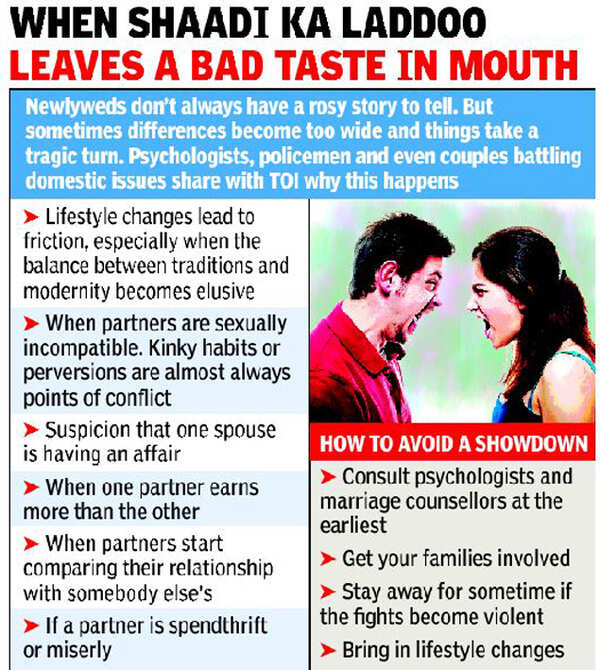
The New Year seems to have begun on a violent note with the city witnessing two incidents of marital discord ending in gruesome murders.


TOI spoke to psychologists and police officers on the growing trend of domestic conflicts. “The primary cause for such outbursts is the lack of self-control and anger management—a problem prevalent among youngsters these days. Most of the time, working professionals get into wedlock without being prepared for it and expect everything to fall in place immediately. Work-related stress also affects relationships. I would suggest people to go through de-stressing programmes or get into productive discussions to make sure that such situations do not arise,” says Avdesh Sharma, a psychologist.
A senior police officer, who counsels the fighting couples, says that a majority of incidents of domestic violence are an outcome of sudden rage. “The police have little to do in such cases if the woman does not approach us. But when they do, our aim is to reduce tension. If they don’t agree, we go for the legal course,” says Varsha Sharma, DCP, special police unit for women and children (SPUWC).
In some cases, the aggressor starts feeling guilty after realizing that they have committed a murder or tried to kill the spouse and then resorts to suicide.
“Fearing arrest or social stigma, the husband tries to end his life. In almost all the cases of a fatal attack or bid on their partners, we found that the husband had committed or attempted to commit suicide,” says an officer.
Psychologists say that violent fights are related to mental illness and immediate help should be sought when they become too frequent.
Nimesh Desai, another psychiatrist, says, “The couple and their families should be more careful whenever instances of marital discord arise. It is a sort of mental health disorder and should be treated. There is no stigma in visiting a counsellor. All such cases begin with small issues which are left unattended for days leading to a major incident.”
Robin Hibu, joint commissioner, SPUWC, says they also have a team of counsellors from Tata Institute of Social Sciences to help the couples with counseling.
“If there is a case of violence, an appropriate case is registered and action taken but this is only when the victim is willing to register a case with a formal complaint. Our efforts are always to keep the marriage intact through counseling,” he added.
End of Article
FOLLOW US ON SOCIAL MEDIA





Hot Picks
TOP TRENDING
Trending Stories
In City
Entire Website
- Breathtaking cosmic catwalk! SpaceX makes history with first-ever private spacewalk
- 2 Army officers thrashed, their female friend gang-raped in Madhya Pradesh
- Bangladesh announce Test squad for India tour
- Top fastest trains in the world: From China's CR Harmony to Germany's ICE
- Amid Shannon Sharpe Viral Video, Former ESPN Host Michelle Beadle Reacts Claiming It Was Not Her
- Ayushman Bharat insurance scheme expanded to cover elderly above 70
- 'Will be demolished if... ': Himachal minister's assurance amid Shimla mosque row
- Mumbai's Haji Ali and Mahim dargahs cancel Eid shamiana
- Garena Free Fire MAX redeem codes for September 11, 2024: Win free room cards, skins, diamonds, pet skins, and more rewards today
- GK for students: Top 8 Largest Mammals in the World
- Bulldozer justice like bulldozing laws of land: Supreme Court
- Maharashtra BJP chief son's 2 friends confirmed drunk 7 hours after accident
- Why Rahul should talk more about jobs and less about ideology
- No ‘Padmar ilish’ in Kolkata this Puja as B’desh stops Hasina’s ‘hilsa diplomacy’
- Virat & Rohit's successors: India cricketer picks these two 'special players'
- India, China to work urgently for disengagement in Ladakh
- Actor dies in his sleep. Why sudden heart attacks are killing Indians
- Refund on iPhone 15 & 14: Apple's policy says conditions applied
- Pakistan stand-off over cops seeking army exit from restive province drags on
- Karthik predicts India's dominance despite B'desh's success against Pak

Popular Categories
Hot on the Web
Top Trends
Trending Topics
Alia BhattMalaika Arora Father DeathArbaaz KhanNatasa StankovicMr Bachchan OTT ReleaseNational Parks In IndiaSelena GomezGOAT CollectionVikas Sethi DeathMalayalam ProducersIndia's Best Dancer 4Simi GarewalDilli BabuIndian National ParksLaung BenefitsVikas SethiiPhone 16Microsoft 365 OutageCsir Ugc Net 2024Wordle Answer
Living and entertainment
Latest News
India successfully flight tests surface-to-air missileFintech Moneyview turns unicorn, 6th one this yearDigest this: Unhealthy gut may be linked to Parkinson’s diseaseCSIR UGC NET 2024 result declared: Steps to download scorecards at csirnet.nta.ac.inWho was Illia 'Golem' Yefimchyk, the Belarusian bodybuilder who consumed 2.5 kg of meat and 108 sushi pieces daily before his death at 36?WWE Star Discusses Why Sid Vicious Deserves a Hall of Fame SpotCatching up with sports stars in DelhiSalman Khan surrounded by bodyguards as he arrives at Malaika Arora's mother's house to offer his condolences - WATCHCMF Buds Pro 2 by Nothing review: Big delivery on a budgetMallika Sherawat makes big screen comeback in Rajkummar Rao's 'Vicky Vidya Ka Woh Wala Video'; director reveals why he cast herArbaaz Khan spotted outside Malaika Arora's house along with police after the tragic news of her father's demise by alleged suicide - WATCH VIDEOMitchell Schwartz's Cryptic Tweet Stirs Debate About Mahomes' ContractSiddhant Chaturvedi reveals he rejected Ranbir Kapoor, Alia Bhatt and Amitabh Bachchan starrer Brahmastra after father’s advice: 'He asked me, ‘Tujhe kaun dekhega?''EcoR unloads 100 million tons of goods in just 160 daysBritain’s one of the largest mobile services providers BT Group raises cybersecurity alarm: “...every 90 seconds hackers are checking…”Youth shows interest in liquor businessMan shot near Delhi's Greater Kailash-I gym, gang war suspectedTamil Nadu students prefer only two-language policy, minister Ponmudy says
Copyright © 2024 Bennett, Coleman & Co. Ltd. All rights reserved. For reprint rights: Times Syndication Service